
Cambodia
🟢 Updated: May 2026
Article
Cambodia 2026: Tolerance vs. Tradition
In 2026, Cambodia still has a fading reputation of abject poverty. That is simply not true anymore. While you will find poor people, even some very poor people, the middle classes are on the move and flourishing since the days of the Khmer Rouge, and behind them, incrementally, the poor are moving up too.

Phnom Penh's Riverside: A bustling public space with a lot of LGBT visibility and Cambodia's "live and let live" culture is most visible.
Cambodia is now one of Southeast Asia’s most accessible destinations for LGBT travelers and can beat many Western countries on its levels of safety. Yet for the LGBT community, it exists under a "polite silence." While same-sex activity is legal, a culture of strong nationalism dominates with a generally conservative and older generation to ensure that LGBT visibility remains a calculated risk for local citizens.
To paint a picture of every day life and reveal a glimpse of modern Cambodia culture, let's have a peek at the law.
Legally, the Cambodian Criminal Code does not prohibit same-sex relations but has confusing laws/rules. The age of consent is equalized at 15 but in a conservative culture, sex is still only acceptable within marriage. The liberal vs. the conservative sums up Cambodian culture as a silent disagreement between the younger generations and the elders. While the gay bars and clubs provide a private space and are full on Pride Weekend, the public facing Tuk-Tuk 'Pub Crawl' and similar events are populated by only the most out-going and socially secure Khmer personalities of the local gay community and the foreigners who have fun with Western confidence.
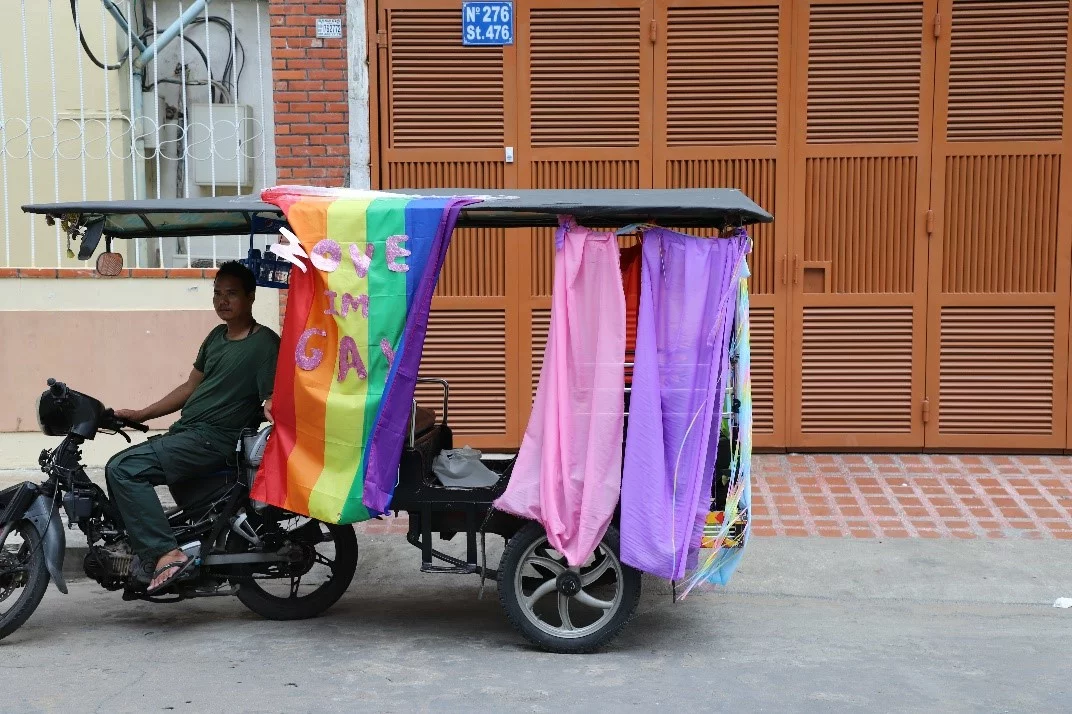
The iconic Cambodian Tuk-Tuk: Here pictured as part of the Pride 'Pub Crawl': 2025.
There is zero legal recognition for same-sex couples, but you can have your relationship formally 'blessed' in a 'progressive' temple. These blessings carry no legal weight, but they are a significant source of social and spiritual validation for local couples, and in this Buddhist culture, that trumps the law. There are no hate crime protections, although you can report anyone for attacking you for anything. For a normal tourist experience, as with many developing countries, you'll see people driving a scooter with no helmet with little to no objection from the police outside the city. You do the same thing and you're spotted by the police and can expect a pleasant and polite conversation, followed by a small fine of around 5 dollars which will go directly into the officer's pocket. The process isn't conscious discrimination against the foreigner, the officer is just thinking that you are rich enough, and a small fine is not going to affect you in any way, apart from giving you a wonderful story about how polite the police are in Cambodia.
Money talks in Cambodia and if you have it, you will get protection via a bribe or "gift" or sometimes just the perception of your 'privilege'. For this reason, even though Cambodia is often marked as a 'budget' travel destination on the traditional backpacker 'hippy trail', Western tourists are generally thought of as rich and so they automatically get protection, even in advance of a bribe. I asked a local waiter about this once, and he replied convincingly, "You flew here, so you must have money." I made sure to tip him. For the local people, there is no such privilege and no protection for the poorest levels of society. The state has no obligation to protect you from bias-motivated crimes or disinterested police who often remain blind to crime unless awakened by some dollars.
The 2026 political climate is heavily influenced by a "Khmer Values" narrative. While the younger generation in Phnom Penh and Siem Reap are vocal and progressive, the government occasionally aligns with conservative religious leaders to perform "morality sweeps," often timing these actions to gain domestic and political strength and distract from any other government failings. A divide and conquer narrative that is used internationally. While posing as a democracy, Cambodia is the opposite, with the political opposition silenced by all the usual measures that autocracies use.
The "Public Shame" Protocol
A specific local threat is the "Media Parade." Authorities have a history, although rare, of raiding LGBT-frequented spaces and forcing local patrons to sit before television cameras for "public shaming." Tourists are typically cleared from the premises beforehand to protect the tourism brand, leaving locals to face the social fallout alone. However, it must be emphasized that these raids are very rare, and only usually occur to distract when the police is failing in some other area in the public mind.
Khmer Pride & Progress

In 2026, the push for visibility continues: Local activists and international partners working to ensure that "no one is left behind" in Cambodia's journey toward equality.
Local NGOs like RoCK (Rights of Cambodian Khmers) continue to push for marriage equality, but they operate under the shadow of heavy nationalism, and this particular 'push' upsets many traditionalist religious types. Many LGBT Cambodians feel a deep sense of patriotism, which often leads to an internal "don't ask, don't tell" culture that prioritizes family respectability over individual visibility. The result of pushing for legal marriage instead of a legal 'civil' partnership has created an 'anger argument' and backlash against the acceptance of the LGBT community from some conservative and religious sectors of society. However, as 2026 progresses, these are increasingly seen as minority views. There is now tangible progress on the issue of equal marriage rights, with the King openly supporting gay marriage, and the government trying to work out how to implement it. The Cambodian community should be proud of their progress and we will be watching this issue and will update you in the 'Rights' section as soon as this motion becomes law.
"Members of the LGBTQ+ community are increasingly confident in expressing their identities, while stigma and social prejudice have declined."
— Khmer Times
In summary: For a visitor, Cambodia is a welcoming land of "live and let live" where the most you are likely to suffer is being over charged a little or having your phone snatched on the Riverside - Phone snatching is a common experience in that area of Phnom Penh so be aware. For a local, it is a society where your social presence depends on staying within the limits of traditional discretion. However, one size doesn't fit all, and there are many LGBT people who live very open and successful lives, though this is mostly in a bubble and centered in the city. Most of these people will also adapt to social 'norms' when visiting family in more rural settings.